

04 November 2025
New datasets published for kite aerodynamics research
BRIEF NEWS
Advancing kite aerodynamics through open data and machine learning models
Under the MERIDIONAL project, two new datasets have been published on the Zenodo of the project, providing valuable resources for the research community in aerodynamic modeling, airborne wind energy, and machine learning in fluid dynamics.
- Data of Wind Tunnel Load Measurements (Rigid Scale Model)
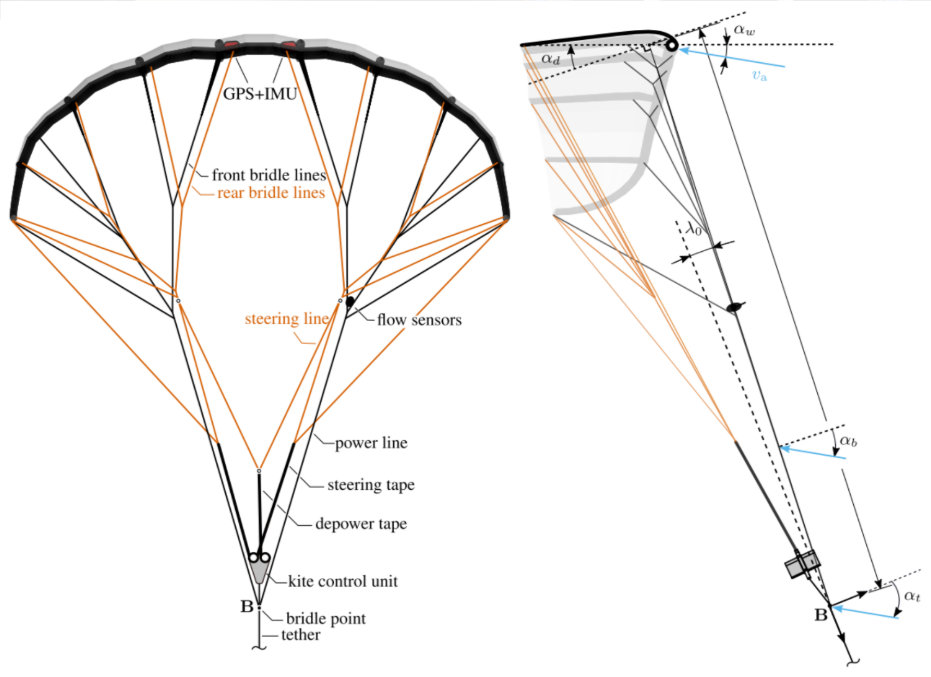
This dataset includes measurements taken in April 2024, in the Open-Jet Facility (OJF) at TU Delft, using a 1:6.5 rigid scale model of a kite developed by the university. It comprises raw load measurements across various angles of attack and sideslip, repeatability tests, sensor drift measurements, and support-structure baseline data, as well as CAD geometry files and computed aerodynamic polars. The data supplement the associated study “Wind Tunnel Load Measurements of a Leading-Edge Inflatable Kite Rigid Scale Model“. The data are also available at the public repository here or on the website. - Machine Learning Models for Leading-Edge Inflatable Airfoil Aerodynamics
This repository hosts trained machine learning models developed to predict aerodynamic coefficients of Leading-Edge Inflatable (LEI) kite profiles. The models are designed to serve as regression tools for lift, drag, and side-force behavior across varying flow conditions and profile geometries. The Vortex Step Method (VSM), developed by AWEgroup and available as open source on GitHub, plays a crucial role in the MERIDIONAL project. This computational tool is essential for predicting the aerodynamic loads of LEI kites, enabling more accurate modelling and performance assessments.
Why these matter
- The wind tunnel dataset provides a robust experimental benchmark for validating aerodynamic simulations and models of inflatable kite systems.
- The machine learning repository allows users to directly apply trained models or use them as a basis for further refinement, exploration, or integration into design workflows.
- Together, they help bridge experimental, computational, and data-driven methods in the development and assessment of kites for airborne wind energy or related applications.
You are welcome to explore, reuse, and build upon these resources under their respective licenses. Explore Meridional Zenodo channel here.