

29 July 2026
Coordinated control of ground station and tethered UAV for airborne wind energy systems
BRIEF NEWS
A new MERIDIONAL paper tackles one of the least-explored phases of airborne wind energy operation: takeoff and landing. Discover it here.
MERIDIONAL‘s researchers have just released the new paper “Coordinated control of ground station and tethered UAV for airborne wind energy systems“, published in Mechatronics. The work, carried out by Politecnico di Milano and EPFL, addresses the takeoff and landing phases of Vertical Take-Off and Landing (VTOL) airborne wind energy systems (AWES) – a topic that, unlike the power-generation phase, has so far received comparatively little attention despite being essential to system operation.
The authors developed a centralised control strategy based on a Nonlinear Model Predictive Controller (NMPC), coordinating the tethered aircraft and the ground station’s winch through a single optimisation-based framework. A supervisory module adapts the controller’s priorities in real time according to the current flight phase: during takeoff it keeps the tether slightly slack while tracking a position reference; during landing it guides the aircraft along a virtual “landing line” toward the ground station while reeling in the tether.
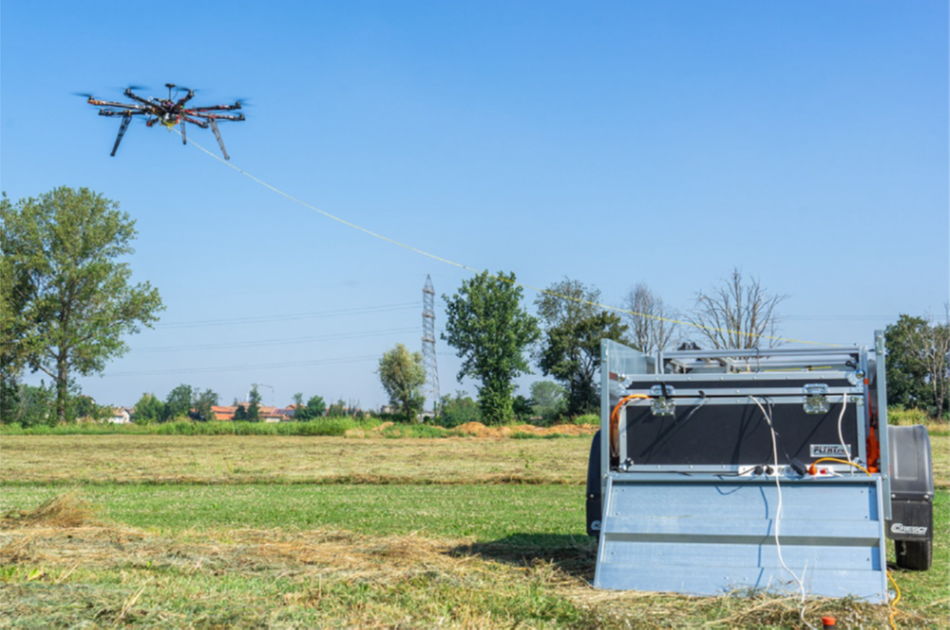
The approach was validated both in simulation and through real-world field experiments, using a tethered octocopter and a custom-built ground station as a representative small-scale testbed. Results confirm the feasibility of the coordinated strategy, with computation times comfortably within the real-time control budget, and lay the groundwork for future autonomous take-off and landing of full-scale AWES.
These and further results are reported in the full paper.
Download it from MERIDIONAL’s Zenodo!